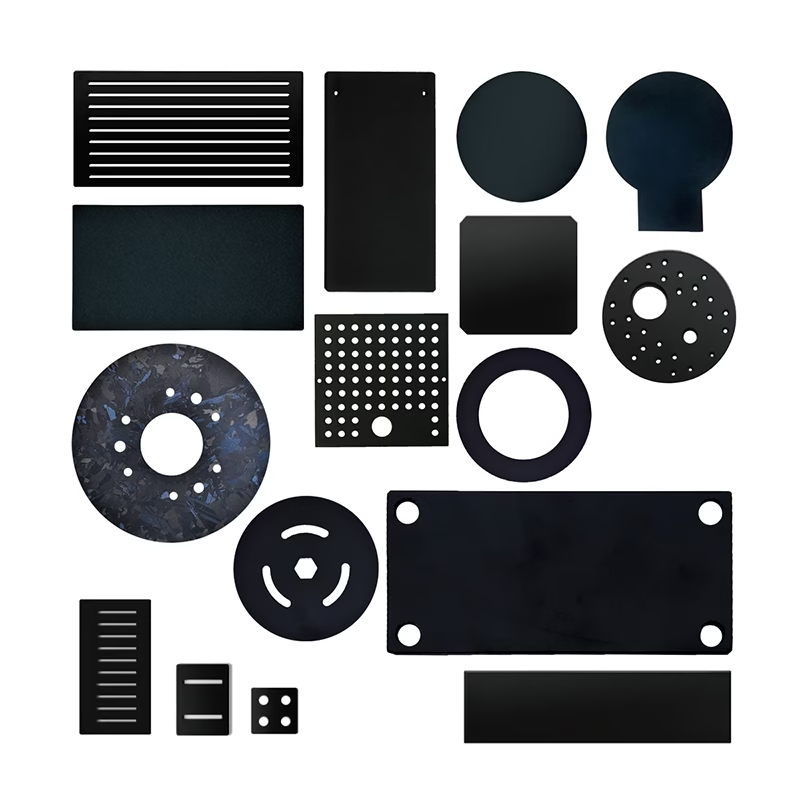
BDD Electrode Plate

BDD electrode , a next gen electrode material made of boron-containing diamond, with exceptional properties and advantages such as outstanding conductivity, chemical stability, widest potential window, remarkablely low background current, superior electrochemical efficiency with expedited electro-generation of reactive oxidizing agents, BDD electrodes are usually fabricated via chemical vapor deposition (CVD). 

Product Description:

Introducing BDD Electrode

The special sp3 bond structure of boron-doped diamond film and its electrical conductivity give the diamond film electrode excellent electrochemical characteristics, extremely high oxygen evolution potential and widest electrochemical window, lower background current, and better physical and chemical stability and low adsorption characteristics. It is an ideal anode material for electrochemical oxidation treatment of hard-to-biodegrade organic wastewater.

In this content, we mainly introduce synthesis/fabrication processes, major properties, characteristics and specifications, applications of boron doped diamond BDD electrode, an excellent electrode material, and video to introduce this BDD anode manufacturer utilizing advantages of BDD anodes for electro-oxidation wastewater treatment processes, followed by suitability for treating refactory pollutants, BDD anode enabled electro oxidation wastewater treatment solutions and further development with Boromond. 

Boron Doped Diamond BDD Electrode Specification

Substrate: Monocrystalline Silicon (BDD/Mono-Si Electrode); Polycrystalline Silicon (BDD/Poly-Si Electrode), Niobium (BDD/Nb electrode)
Electrode Shape: rectangle,square, mesh, disc, custom                                                                                                                                                                  External Size: Custom, specific up to 500*300 mm                                                                                                                                                                   Thickness Tolerance: ±0.05mm                                                                                                                                                                                                              Crystal type: Polycrystalline                                                                                                                                                                                                                            Film Thickness: 10-20 um                                                                                                                                                                                                                              Grain Size:< 2um                                                                                                                                                                                                                                              Film Structure: Micro Crystalline                                                                                                                                                                                                                  Edges handling: Laser Cut

Electrochemical Properties:                                                                                                                                                                                                                      Boron concentration (typical): 5000-6000 ppm                                                                                                                                                                                            Bulk resistivity(Rv): 10-1000mΩ·cm                                                                                                                                                                                                              Solvent window: >2.7V                                                                                                                                                                                                                                  Oxygen evolution potential(V): ≦2.75                                                                                                                                                                                                        Hydrogen evolution potential(V): ≧-1.2                                                                                                                                                                                                  Measured Potential Window (V): ≦3.85                                                                                                                                                                                                Read more about parameters contribute to the function of BDD electrodes from ACS Publications

Nucleation side fracture stress: 500  MPa                                                                                                                                                                                                  Growth side fracture stress: 500 MPa                                                                                                                                                                                                          Young’s modulus: 450 Gpa                                                                                                                                                                                                              Roughness(Ra): 10 nm                                                                                                                                                                                                                                    Thermal conductivity: 800 W/m/K                                                                                                                                                                                                             *Check the structure of BDD electrode from MDPI

Substrate Versatility, Which BDD Plate Is Suitable for you? Si-substrate or Nb-substrate

Choosing between Silicon (Si) and Niobium (Nb) substrates for your Boron-Doped Diamond (BDD) plates isn’t just a technicality—it’s the difference between a high-precision lab sensor and an industrial-scale powerhouse.

Based on the latest material performance benchmarks and the recent shifts in electrochemical manufacturing, here is the breakdown of basic characteristics, suiable applications, advantages, and trade-offs, when it comes to choosing Si-substrate or Nb-substrate, hope to facilitate you while determining which substrate is suitable for your specific operational goals.

Si-substrate BDD Electrode

Silicon-based BDD plates are the gold standard for analytical chemistry and micro-electronics. Because silicon is a semiconductor, the interface creates a heterojunction that requires precise doping to manage electron transfer.

Best For: Electrochemical sensing, trace element detection, and laboratory-scale R&D.

The Advantage: Silicon wafers allow for incredibly smooth, uniform diamond film growth. If you are integrating BDD into a microfluidic chip or a high-sensitivity sensor, Si is the undisputed winner due to its compatibility with standard microfabrication processes.

The Trade-off: Fragility. Silicon is brittle. In high-pressure industrial flow cells or environments with significant thermal cycling, Si-substrates are prone to cracking.

Nb-substrate BDD Electrode

Niobium is a refractory metal, and when used as a BDD substrate, it changes the game for wastewater treatment and electrosynthesis. The metal-semiconductor junction at the Nb/BDD interface typically allows for more robust current distribution.

Best For: Advanced Oxidation Processes (AOPs), PFAS destruction, and heavy-duty industrial electrolysis.

The Advantage: Physical toughness. Niobium can be fabricated into complex shapes—large plates, meshes, or expanded grids—that silicon simply cannot sustain. It handles the “rough and tumble” of turbulent industrial wastewater without the risk of substrate fracture.

The Trade-off: Cost and Weight. Niobium is a premium metal. While it offers superior longevity and mechanical stability, the initial capital expenditure (CAPEX) per square centimeter is higher than silicon.

Chemical Vapor Deposition Process for Boron Doped Diamond (BDD) Electrode Fabrication

The fabrication of Boron Doped Diamond (BDD) electrodes is a sophisticated marriage of plasma physics and materials science. Unlike traditional coating methods, creating a functional BDD layer requires precise control over carbon atom arrangement to ensure the resulting film is both conductive and indestructible in electrochemical environments, as well as strict technical sequences. Here at Boromond, we adopt Hot Filament Chemical Vapor Deposition (HFCVD), as it’s one of the most dependable approach to farbicate boron doped diamond (BDD) electrode for commercial implements. 

bdd electrode synthesis and fabrication processes by chemical vapor deposition machinery

Before deposition, a intractable base material such as Niobium (Nb) or Silicon (Si) is need be accurately handled with mechanical abrasion or acid etching to create a minuscule “profile” that expedite mechanical combining. Nanodiamond powders are needed to initialize diamond lattice growth, avoid substrate-surface detachment and penetrable with high density seedings.

In HFCVD, a mixture of hydrogen and Methane will be pumped into the vacuum chamer, then tungsten filaments are heated to over 2000°C, breaking gas molecules into reactive radicals. Trimethylborate as the boron source, is introduced into the mixed gas stream. Boron atoms eventually replace some carbon atoms in the diamond lattice.

Carbon radicals deposit onto the seeds, forming a continuous polycrystalline diamond film. The ratio of Boron to Carbon (B/C ratio) determines whether the electrode behaviors will be determined by the Boron to Carbon ratio.

Boron-Doping in sp³/sp² Ratios On Boron Doped Diamond BDD Electrode

Boron-Doped Diamond (BDD) electrode is widely considered the “gold standard” for non-active anodes. 

However, its performance is not universal; it is determined by the atomic structure of the diamond film during the Chemical Vapor Deposition (CVD) process.

The sp³ / sp² Balance with BDD Electrode, Why It Matters

sp³ Carbon: This represents the tetrahedral diamond lattice. A high sp³ content provides the chemical inertness, corrosion resistance, and the wide potential window (high OEP) necessary for efficient hydroxyl radicals production.

 sp² Carbon: This represents “graphitic” impurities. While some  sp² carbon can increase conductivity, an excess reduces the OEP. Too much graphitic content causes the anode to behave more like an “active” electrode, leading to surface fouling and lower oxidation efficiency.

Boron-Doping Levels with Borond Doped Diamond (BDD) Electrode

The introduction of Boron atoms into the lattice transforms the diamond from an insulator into a semiconductor.

Low Doping: Results in high resistance and poor current distribution.

High Doping (>2000 ppm): Leads to “metallic” conductivity.The engineering challenge lies in achieving a high Boron concentration (for conductivity) without collapsing the sp³ diamond structure into sp² graphite. 

By maintaining a high sp³/sp² ratio, BDD anodes can operate at high current densities without degrading, providing the most stable environment for long-term industrial wastewater remediation.

Why BDD Electrode? More Three Advantages, Ready To Explore?

Boron-Doped Diamond (BDD) electrodes represent a generational leap in electrochemical oxidation, moving far beyond the limitations of traditional mixed metal oxides or graphite. Synthesized as polycrystalline diamond films—typically anchored to niobium or silicon substrates—these anodes offer a level of chemical and mechanical stability that was previously unattainable.

While standard electrodes often degrade within months or a few years in aggressive environments, a well-engineered BDD system can maintain its structural integrity for one to two decades. This longevity isn’t just a matter of durability; it’s a fundamental shift in the cost-benefit analysis of industrial water treatment.

Total Mineralization

Instead of sorting persistent organic pollutant, BDD anode destory these organic matter by direct oxidation, aka direct electron transfer, and indirect oxidation, redox oxidants.e.g, hydroxyl radicals to oxidize them into intermediates, then further oxidation to carbon dioxide, water,etc.

Complex Water

BDD anode excels in industrial wastewater with high organic loads, bio-refractory, or considered hard to treat via conventional physical, chemical, conventional AOPs, high salinity RO concentrates, brine-heavy, toxic, electrity is the sore reagent ever required within the whole treatment process.

No or few Sludge

Unlike chemical coagulation or Fenton’s processes, BDD electrode-driven electro oxidation wastewater treatment process is a “clean” electron-based reaction, removing the need for massive chemical dosing and the subsequent disposal of those hazardous sludge. It’s can be a great approach to realize sustainability goal.

Beyond the Lab: Why Boron Doped Diamond (BDD Electrode is Outperforming DSA Electrode in Industrial Scale Implements

A Comparison of BDD Electrode And Conventional Electrode Matrials

Boromond present data and information based on our 12 years of experiences with electrode material selection for electro oxidation wastewater treatment to compare BDD electrode and conventional electrode under the same operation parameters such as current density, retention time, initial TOC or COD value, and exactly the same water sample, check the chart below for more details.

a comparison of bdd electrode vs lead dioxide electrode pbo2

Pollutant molecules must be adsorbed onto the PbO2 surface to able to be oxidized while unique SP3/SP2 strture, semiconductor nature of BDD electrode make the surrounding area a location where highly intensive oxidation happens, PbO2 electrode is oftenly fouling if there are substances impact the lead surface, which make COD removal with the lead dioxide electrode a restrained, linear redox process, bdd can make the COD reach undetectable level, while lead dioxide electrodes are limited.

Organic pollutants mineralization COD degradation rate of BDD anode reaches some 92%, yet save 30-55% of the time with PbO2 anode when it comes to complex industrial waste streams, as the whole surrounding area of the “non-active” BDD anode is a highly intensive oxidation zone.                                                                                                                                                                    Our electrode material engineers conducted a side-by-side comparison of BDD anode and lead dioxide electrode, recorded a 50% higher on color removal, 25% on higher on COD degradation rate, then some 45% lower on actual electric energy consumptions. *actual data might defer under different conditions.

a comparison of bdd electrode vs platinum electrode

Platinum has a relatively low oxygen evolution overpotential (OEP) at some 1.6V, which means a certain part of energy is consumed with water splitting, while “active” nature of Pt make the oxidants, e.g, hydroxyl radicals adsorbed strongly to the Pt surface to form PtO, make the redox process selective, competing with the oxidation of organic compounds and reducing current efficiency. therefore Platinum is effective for scenarios when it require simple disinfection or partial COD removal, organic pollutants can be easily oxidized.

With the widest electrochemical window, OEP over 2.3V, non-active BDD electrode has very weak adsorption of oxidants e.g. hydroxyl radicals, meanwhile spend most of the energy on the oxidant generation instead of side reactions like water splitting, non-selective breaking down organic pollutants into intermediates, then further oxidation into CO2 and water.

This engineering team recorded BDD electrodes have some 30% to 50% higher than platinum electrode with TOC removal rate under the same current density and redox time, all the data and information are collected during our testing.

BDD electrode vs DSA electrode

With oxidation potential at 1.6V to 1.8V, DSA electrode usually consist of titanium substrate with mixed metal oxides coating such as IrO2, RuO2. Hydroxyl radicals and other oxidants are adsorbed to the surface to enable selective oxidation of those organic compounds with simpler structures, ammonias, or pathogens, makes DSA electrode cost effective for large scale municipal application with a high flow, low complexity.

With an oxidation potential at 2.3V to 2.7V, BDD electrode can break down refractory organic pollutants with complex bonds /structures, e.g, PFAS, phonels, aromatic hydrocarbons, “Non-active” BDD electrode has weak affinity for hydroxyl radicals, which means oxidants remain highly reactive near the surface. 

This results in highly efficient treatment of complex industrial effluents e.g. pesticides, petrochemicals, chemical production, pharmaceutical, landfill leachate, and those waste streams resists conventional biological or physical-chemical treatments

Application of BDD Electrode In Electro Oxidation Wastewater Treatment

application of bdd electrode in electro oxidation wastewater treatment processes

From a wastewater treatment perspective, this unmatched hydroxyl radicals generation capability makes BDD electrodes particularly suitable for practical treatment of complex industrial wastewater, espeically waste streams with a high concentration level of persistent organic pollutants, high salinity, or high COD, these wastewaters are refractory to conventional biological and physicochemical treatment methods.

Therefore deep oxidation and byproduct mitigating are critical elements for performance evaluations, that is where BDD electrode step in with a true non-selective electro oxidation process thanks to hydroxyl radicals produced in bulk, as •OH radicals indiscriminate wider range of organic compounds, breaking them down through consecutive oxidation steps to realize full mineralization to CO₂ and H₂O. 

What is more, BDD anode does not promote the formation of surface-bound oxidants or active chlorine species unless high halide concentrations are present, which slash the risk of persistent or toxic byproducts formation.

Find out how bdd electrode degrade refractory organic pollutants, and mechanisms of direct and indirect oxidaiton in eletro oxidation wastewater treatment processes.

Explore availability of bdd electrodes at different sizes, substrates and shapes ready for electrochemical oxidation wastewater treatment within the chart below.

What is more, if you are interested in investigating electrochemical oxidation treatment of wastewater utilizing BDD electrode for your specific waste water, especially those complex organic wastewater, share us your water profiles including COD, BOD, coloration, TOC, TN, and etc, to get a free wastewater analysis, we will offer all the information you need before investing in electrochemical oxidation wastewater treatment products, not just fundamental catalyst electrode materials, feel free to initialize a discussion about the possible treatability of electro oxidation toward your water now.

Consult with a BDD Application Engineer

Unleash the full potential of BDD electrode in your research and wastewater treatment endeavors with our dedicated technical support team.

Elevate your experiments with our unmatched bdd electorde customization and stellar service with diamond electrode synthesis technology.

Reach out today and let us transform your needs for optimial electrode materials and into bespoke solutions for unmatched success.

Get a water profile analysis, free of charge, get to know the treatability of your wastewater now, it's a wise decision to make before investing bigger money.

Employing optioneering electro oxidation wastewater techniques with boron doped diamond bdd anode as basic component to pinpoint the most suitable industrial wastewater solution.

Send Us A Message

Related Posts

Scroll to Top