
Electro Oxidation funamentals: Science Behind Electrochemical Advanced Oxidation processes Explained
The Science of Electrochemical Advanced Oxidation Processes (EAOPs)
As one of the most innovative and most efficient advanced oxidation proceses (AOPs), Electrochemical Advanced Oxidation Processes, EAOPs for short, established a trackable efficient record toward waste streams, especially industrial wastewater treatment with electrochemical combustion, oxidation then mineralization of persistent organic pollutants (POPs) into carbon dixoide, water, and inorganic salts, instead of breaking water molecules into offering a robust solution for the degradation of persistent organic pollutants (POPs) that traditional biological or chemical treatments fail to address. At the heart of this technology is the “Anodic Oxidation” process, where electrical energy is harnessed to generate highly reactive species directly at the electrode surface.
Unlike standard electrolysis, which might focus on simple redox reactions, EAOPs are engineered to achieve mineralization—the complete conversion of complex organic molecules into water, carbon dioxide, and inorganic salts.
Electrochemical Advanced Oxidation Process Mechanisms
EAOPs employ direct electron transfer among the anode and organic compounds at the anode, aka direct oxidation, and indirect oxidation, that is the electrochemical combust of water molecules and generation of reactive oxidants on the surface of the anode, e.g, hydroxyl radicals with a high electrochemical oxidation potential, and an non-selective nature, to decompose organic contaminants in different pathways.
Direct Oxidation via Electron Transfer
The organic pollutants adsorbs onto the electrode surface and loses electrons directly to the anode. This is typically efficient only at low concentrations or when the pollutant has high affinity for the electrode material.
Indirect Oxidation: Oxidation Via Hydroxyl Radicals
The efficiency of an EAOP wastewater treatment system is primarily dictated by the properties of the anodic electrode material. Anode electrode materials function as electrocatalytic function, or say catalyst electrode material types are devided into two paralleled categories, active anode and non-active anode, based on how each group of anodes interact with the major oxidant in electrochemical advanced oxidation process, hydroxyl radicals (ᐧOH), feel free to check out how hydroxyl radicals functions in wastewater treatment via the hydroxyl radical for wastewater treatment content.
Hydroxyl Radical Generation & Indirect Oxidation with Active Anodes
Actice anodes generate hydroxyl radicals via the pathway within the right section: MOx + H2O ⟶ MOx(ᐧOH) + H⁺+ e⁻
Active Anodes such as IrO₂, RuO₂, Pt interact strongly with ᐧOH, often leading to a high rate of further oxidation to higher-valence metal oxides (MO𝑥), which slashes the amount of ᐧOH available for water treatment, which means a lower current efficiency for organic degradation, followed by a comparatively much lower organic pollutants removal efficiency.
These anodes typically favor selective oxidation or electrochemical conversion. Because the radicals are “trapped” on the surface, they are less available for the unselective destruction of complex organics, often leading to partial degradation, that is intermediates generation instead of further oxidation, then full mineralization.
Reactive Radical Production & Indirect Oxidation with Non-Active Anodes
Non-Active anodes exhibit “inert” surface properties with very low adsorption energy for hydroxyl radicals, that is no or few interactions amongst the anode surface and reactive radicals. This allows the radicals to remain “physically adsorbed” and highly mobile.
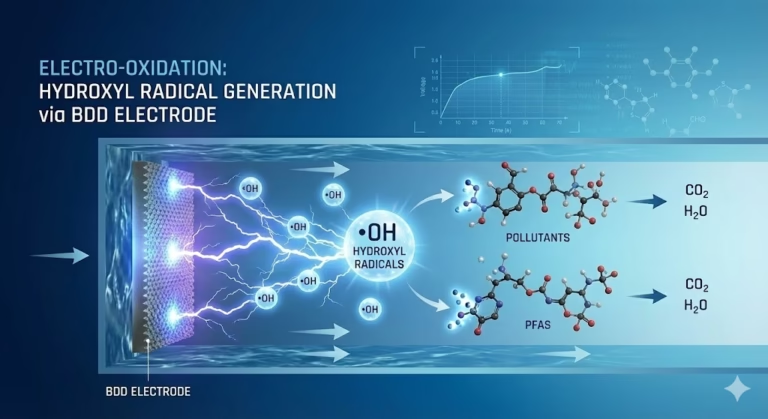
Hydroxyl radicals generation via non-active anodes follow this pattern: M + H2O ⟶ M(add ᐧOH) + H⁺+ e⁻ , these non-active anodes facilitate unselective oxidation. The ᐧOH radicals exist in a quasi-free state, possessing a much higher oxidation potential. This is the preferred mechanism for organic compounds oxidation, then enhance possibility of complete mineralization, as the hydroxyl radicals are aggressive enough to break down even the most stable carbon-fluorine or aromatic bonds by non-selective oxidation via their four unique pathways: hydrogen abstraction, addition to unsaturated bonds, electron transfer, then radical combination.
Major Electrochemical Advanced Oxidation Proceses Explained
Electro oxidation or anodic oxidation is one of the major electrochemical advanced oxidation processes that widely adopted in real world wastewater management operations, yes, you can tell by the name of this specific process, all the direct oxidation (direct electron transfer) as well as indirect oxidation (in-situ physisorbed hydroxyl radicals production), happen on the anode surface.
Other EAOPs encompass Electro-Fenton (EF), Photoelectrocatalysis (PEC), Electro-Persulfate Activation, check the concluded three EAOPs below:
Electro Fenton process involves in -situ electrochemical production of Hydrogen Peroxide (H₂O₂) at the cathode, which then reacts with additional ferrous ion (Fe²⁺) to generate hydroxyl radicals (ᐧOH). Elctro Fenton can effciently slashes the need for transporting ,storing hazardous concentrated peroxide.
By applying an external bias to a semiconductor electrode, for instance, TiO₂ electrode under UV or visible light, researchers can inhibit the recombination of electron-hole pairs, drastically increasing the quantum efficiency of the oxidation.
PEC is an approach for organic pollutants degradation.
Recent trends of the Electro-Persulfate Activation involve using electrochemical cells to activate persulfate ions (S₂O₈²⁻), to produce sulfate radicals (SO₄˙⁻) which offer longer lifetimes and higher selectivity in certain saline wastewater environments.
E-PS can be adopted to treat various types of wastewater.
Main Advantages of Electrochemical Adanced Oxidation Processes
EAOPs, especially anodic oxidation can destruct persistent organic pollutants and microbes effectively,
Electron is the reagent that EAOPs utilizing all the time,which means there is few to no adding of external chemical dosing.
Capable of treating various types of waste streams, especailly those are with high organic loads, toxic, refratory for bio, etc.
Highly amenable to PLC (Programmable Logic Controller) integration and real-time current density adjustments.
Major Challenges while Implementing EAOPs for Wastewater Treatment
In water with high chloride levels, there is a risk of forming chlorates or perchlorates if the potential is not well controlled.
Since electrical power is the major source to drive oxidation process, EAOPs generate a large cost on electricity.
Fabricate and optimize electrode materials to maximize hydroxyl radical production, and boost pollutants degradation while avoid electrode fouling
How To Mitigate Challenges with EAOPs for Wastewater Treatment Implements
We can mitigate challenges with EAOPs when it comes to wastewater treatment by selecting catalyst electrode materials, especially optimal anode materials, for instance, boron doped diamond (BDD) electrode to maximum reactive oxidants generation, introducing renewable energy to slash the total electric costs, other approaches including enhancing operating condictions, combining with treatment methods to reach better intaking water for better organic pollutants degradation or polishing.
Optimal Boron Doped Diamond (BDD) Anode
- Ideal Anode Material for Electrochemical Advanced Oxidation Processes for you
Premium Quality Borond Dopd Diamond BDD Electrode for Better Results
By integrating these fundamentals—matching the specific anode mechanism to the pollutant profile and optimizing the sp³ structural integrity, engineers can design EAOP systems that significantly outperform traditional chemical oxidation in both longevity and environmental impact.
Find the right anode with perfectly balanced sp³ / sp², boron doping level, ideal material for your electrochemical advanced oxidation processes applications, click a take closer look now
Reducing Electricity Cost
Renewable Energy
Using solar or wind energy to enpowering your electrochemical advanced oxidation processes (EAOPs) helps to reduce high operational electricity costs.
Enhancing Operation Conditions
EAOPs Engineering
Optimize electrode spacing, current density, then precise pH control, mass transfer controlling, as well as electrolyte/inffluent pre-treatment, rentention time, flow rate control, batch cycling
Industrial Applications of EAOPs: Wastewater Remediation
The practical application of EAOPs is most evident in “hard” industrial streams where biological systems fail due to toxicity
Leachate is a complex cocktail of humic acids, heavy metals, and ammonia.
EAOPs, particularly when using BDD anodes, can reduce Chemical Oxygen Demand (COD) by over 90% while simultaneously stripping nitrogen, making the effluent safe for municipal discharge.
Antibiotics and synthetic medicines are designed to be stable. EAOPs break down the aromatic rings and heterocyclic structures that give these molecules their persistence and color.
By targeting the chromophores first, decolorization is often achieved within minutes of treatment.
The high salinity of produced water often hinders traditional treatment. However, EAOPs can leverage the existing conductivity of the brine to lower energy consumption.
Using the chloride content to generate secondary oxidants like hypochlorite to assist in the degradation of emulsified oils.
Innovative electrochemical advanced oxidation processes wastewater treatment solutions, services that’s beyond conventional wastewater treatment products, get a free water profile analysis and request a quick quote to embarking future cooperation now.