Strategic Analysis: The Global Boron Doped Diamond BDD Electrode Market
Decade Outlook: 2026–2035
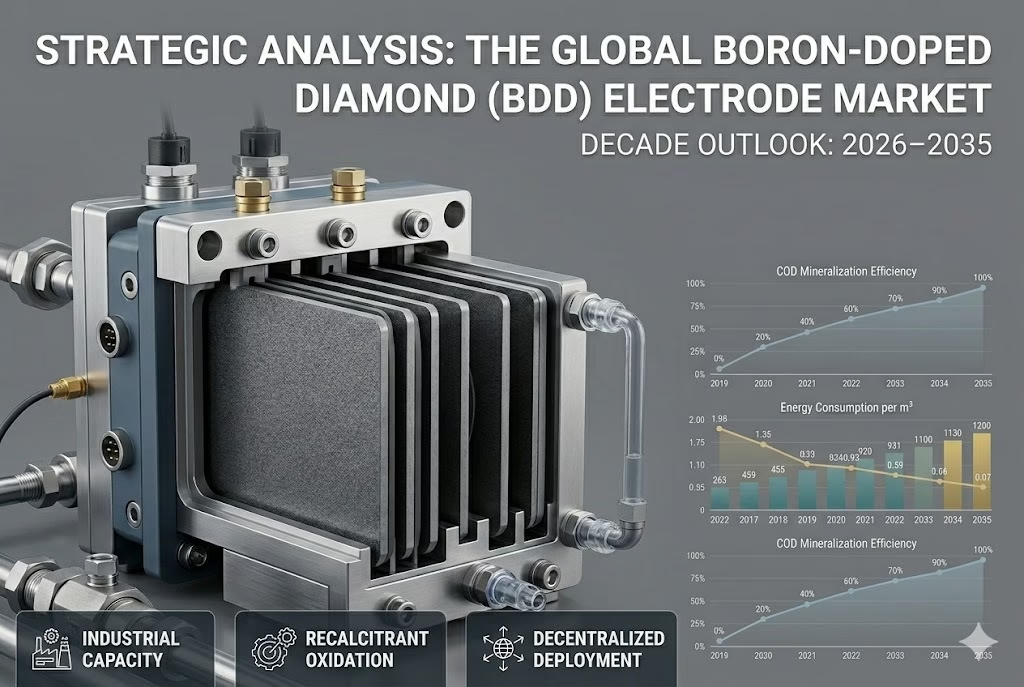
1. Executive Summary of Boron Doped Diamond BDD Electrode Market Report
As of 2026, the Boron Doped Diamond (BDD) electrode industry has pivoted from a niche laboratory curiosity to a critical enabler of high-stakes industrial electrochemistry. The market is currently defined by a “Performance-First” adoption curve, where BDD’s unparalleled chemical stability and wide electrochemical window solve problems that traditional Mixed Metal Oxide (MMO) or Lead Dioxide PbO2 electrodes can not.
The primary growth engine is the tightening global regulatory framework surrounding Persistent Organic Pollutants (POPs), specifically PFAS “forever chemicals.” While manufacturing complexity remains a barrier to entry, recent advancements in Chemical Vapor Deposition (CVD) efficiency are beginning to unlock economies of scale.
Consistency is the silent killer of electrochemical efficiency. A BDD electrode with uneven boron distribution creates “hot spots” that waste energy and accelerate wear. At Boromond, our mission is to deliver atomic-level homogeneity. By perfecting the boron-to-carbon ratio across every square centimeter of our plates, we provide our partners with a predictable, high-yield hydroxyl radical source that performs identically from Day 1 to Day 1,000.
Proprietary Doping Consistency
Zero-Gradient Growth: We utilize advanced plasma-flow dynamics to ensure that boron concentration remains stable within some ±2% across large-format electrodes.
Phase Purity: Our refinement process maximizes sp3 (diamond) content while suppressing sp2 (graphite) impurities, resulting in a wider potential window and lower background noise for sensing and synthesis.
2. Technology Deep Dive: The Electrochemical Gold Standard & BDD Electrode Market
The superiority of BDD is not merely incremental; it is a fundamental shift in material physics. By substituting carbon atoms with boron within the diamond lattice, the material transforms from an insulator to a high-performance semiconductor.
Oxygen Evolution Overpotential: BDD exhibits an exceptionally high overpotential for oxygen evolution (2.3V – 2.7V vs. SHE), allowing for the production of hydroxyl radicals ( •OH) with near-100% current efficiency.
Surface Inertness: Unlike metal electrodes, BDD resists fouling and scaling, maintaining active surface area in “dirty” industrial streams.
Thermal and Chemical Rigidity: Capable of operating in extreme pH environments (0to 14) and high current densities without substrate delamination.
BDD Electrode Application in Electrochemistry and Beyond
Boron-Doped Diamond (BDD) electrodes represent a transformative leap in electrochemical material science. By introducing boron atoms into the crystalline lattice of synthetic diamond, researchers have created a material that combines the extreme durability of diamond with high electrical conductivity. This unique synergy has established BDD as a superior alternative to traditional carbon-based or noble metal electrodes.
In this context, we invite you to explore ranges of BDD electrode application, and prior to probing application ranges of this innovative electrode material, find out which group of characteristics of BDD electrode make it excel in practical applications.
Core Characteristics of BDD Electrode, Fundmentals for Various Application of BDD Electrode
The widespread adoption of BDD electrode in various science and technology implements is driven by several unique physicochemical properties:
Exceptional Potential Window: BDD electrode possesses an electrochemical potential window at some 3.5 V, which is the widest electrochemical potential window of any known electrode material. This makes BDD electrode an ideal material for the redox/electrochemical reactions instead of decomposing of water, oxygen or hydrogen evolution.
Low Background Current: The capacitive current of BDD eletrode is significantly lower than that of glassy carbon or gold. This results in an exceptionally high signal-to-noise ratio, which is critical for detecting trace amounts of analytes.
Chemical and Mechanical Robustness: BDD is resistant to fouling and corrosion, even in highly acidic, alkaline, or high-pressure environments where other materials would degrade.
Surface Versatility: The electrode surface can be terminated with hydrogen or oxygen to tune its hydrophobicity and elective response toward specific molecules.
Get a better comprehension about premium quality BDD electrode for various electrochemical and industrial application now.
Industrial and Environmental Water and Wastewater Treatment
One of the most important applications of BDD electrode is in electro oxidation wastewater treatment, a type of advanced oxidation processes (AOPs) for wastewater treatment, environmental remediation, and water .
Wastewater Treatment, Organic Pollutants Mineralization, A Critical BDD Electrode Application Angle, Strength of EO
BDD electrodes are uniquely capable of generating hydroxyl radicals directly from the oxidation of water. Because these radicals are loosely adsorbed to the BDD surface, they remain highly reactive. This allows for the complete mineralization of persistent organic pollutants (POPs), such as pesticides, dyes, and pharmaceuticals, into harmless CO2 and water, gas, and some inorganic salts.
Hydroxyl radicals generated around the surface of BDD anode is a potent oxidant with an oxidation potential at some 2.8V as we mentioned within hydroxyl radicals generation page, oxidation capability of hydroxyl radicals are second only to fluorine, please refer to the breakdowns of organic pollutants/compounds oxidation and mineralization via indirect oxidation of hydroxyl radicals generated in bulk on the BDD anode surface, as well as direct oxidation through direct electron transfer.
All the content are created by Jeremy Hwan Hsiao, marketing director of Boromond, Jeremy is the man behind all the content you see across the official website of Boromond then newsletters on social medias, all the contents are created based on his in-depth understanding of chemistry, electrochemistry, and wastewater treatment technologies, and three years of in-field experiences on operation of electro oxidation wastewater treatment equipment and system.
Firstly, we discuss the electro oxidation and mineralization of Cyanide, carbon-nitrogen triple bond of Cyanide can be broke by hydroxyl radicals, facilitated by superoxide radicals, Ozone, etc, while free cyanide reacts with hydroxyl radicals to form cyanate, there are radical addition, e.g. abstraction of C–H bonds of Cyanide, cyanate and other intermediates will be furtherly oxidized into ammonium, carbonate, nitrogen, carbon dioxide. Before you wrapping up, I hope you can comprehend one thing, that is oxidation and mineralization of metal-cyanide complexes, e.g. ferricyanide, required additional technology, for instance, photolysis via UV radiation to release free Cyanide, as stand-alone hydroxyl radical-based indirect oxidation is proven to be inefficient when it comes to metal-cyanide complexes.
Meanwhile electron transfer amongst Cyanide and BDD anode, that is Cyanide molecules lose electron to the anode, this process is called anodic oxidation, Cyanide will be oxidized into fulminate ion, then these fulminate ion will be degraded into nitrogen, carbon dioxide, etc.
VOC
Electrochemical Disinfection
In water purification, BDD electrodes facilitate the “in-situ” generation of powerful disinfectants like ozone, hydrogen peroxide, and free chlorine. This provides a chemical-free method for inactivating bacteria and viruses in both municipal systems and industrial cooling towers, as well as commerical implements such as swimming pool, spa and other scenarios.
Innovations in Sensor Technology and Analytics
The high sensitivity of BDD makes it a cornerstone of modern analytical chemistry, particularly in complex biological and environmental matrices.
Heavy Metal Detection: Using anodic stripping voltammetry, BDD can detect trace levels of lead, cadmium, and mercury in drinking water with parts-per-billion (ppb) precision.
Biochemical Sensing: BDD electrodes are used to monitor neurotransmitters (like dopamine and serotonin) and metabolites (like glucose and uric acid). Their resistance to “bio-fouling” ensures that the sensors remain accurate over long periods without needing frequent recalibration.
Energy Conversion and Storage
As the global demand for green energy rises, BDD is finding a home in the hardware of the future.
Fuel Cells and Electrocatalysis
BDD serves as a robust support material for catalysts in fuel cells. Its stability prevents the “carbon corrosion” typically seen in traditional fuel cells, thereby extending the operational lifespan of the device. Additionally, BDD is being explored for the electrochemical reduction of $CO_2$ into useful fuels like methanol.
Next-Generation Batteries
In high-power battery systems, BDD-coated electrodes can handle rapid charge and discharge cycles without structural degradation. This is particularly promising for lithium-sulfur or redox flow batteries where chemical stability is a major bottleneck.
Electrosynthesis: A Greener Chemical Industry
BDD is redefining synthetic chemistry by enabling **organic electrosynthesis**. Instead of using hazardous chemical oxidants, researchers use BDD electrodes to drive selective oxidation reactions.
This approach is highly valued in the pharmaceutical industry for:
Creating complex intermediates with high purity.
Reducing waste byproducts.
Fine-tuning reaction pathways by precisely controlling the electrode potential.
Challenges and Economic Landscape
While the performance of BDD is undisputed, two primary hurdles remain:
Manufacturing Complexity: Producing high-quality BDD requires Chemical Vapor Deposition (CVD), a sophisticated process involving high temperatures and vacuum conditions.
Initial Cost: The upfront investment for BDD electrode is higher than for graphite or lead-dioxide electrodes.
However, the long-term ROI is often superior. Because BDD electrode does not need frequent replacement and operate with higher current efficiency, the total cost of ownership in industrial scales—particularly when sourced from specialized wholesale manufacturers—is becoming increasingly competitive.
The Path Ahead: Nanostructuring and IoT
The future of BDD technology lies in nanostructuring. By creating BDD nanowires or “honeycomb” structures, scientists can vastly increase the active surface area, leading to even faster reaction rates and higher sensitivity.
Furthermore, the integration of BDD sensors with IoT (Internet of Things) platforms is enabling real-time, remote water quality monitoring, allowing for autonomous environmental protection systems that can detect and respond to contamination events the moment they occur.
3. Boron Doped Diamond BDD Electrode Market Size & Quantitative Projections (2026–2035)
3.1 2026 BDD Electrode Market Composition by Sector
Growth Drivers of boron doped diamond BDD electrode :
Advanced water treatment: Increased demand for specific implement, for instance, electro oxidation via BDD electrode to treat complex industrial wastewaters with persistent organic pollutants that are refractory to coventional physical methods, e.g. activated carbon, traditional physical-chemical apporaches, especially membrane filtration processes such as Reverse Osmosis, Nanofiltration, conventional advanced oxidation processes such as Ozonation (O3 ), Fenton, Photo-Fenton Processes, Photocatalysis, typical biological approaches such as biological activated sludge processes, BDD electrode-based electro oxidation processes pharmaceutical effluent treatment,
Besides full utilizations of chemical vapor deposition coating equipment developed by ourselves, surface termination control process to boost oxygen termimation by adjusting surface hydrophilicity, optimize potential window, then slashing background current, acid treatment to enhance the sp3/sp2 ratios, surface etching to increase the active surface area and capcaitance, extend service life of bdd electrode by adjusting the grain size, reduce boron content, adhesion enhancements via proper substrate pretreatment.
We have a comprehensive laboratory and experimental platform for BDD electrode characteristic debugging and testing, then a manufacturing facility with an area up to 75,000 sqaure meters, Boromond become the sole manufacturer and supplier who can fabricate high performance large area boron doped diamond electrode (BDD) with silicon or niobium substrates in Asia Pacific region.
Besides specific implement like electro oxidation wastewater treatment, potential of BDD electrode shine in specialized electroanalysis (electorchemical sensing), industrial organic synthesis, biomedical and specialty applications, thanks to its unique advantages such as low background currents, resistance to fouling, and high chemical robustness.
| Segment | Market Value (USD Mn) | Strategic Drivers |
| Advanced Water Treatment | 4.8 | PFAS remediation and POPs (Persistent Organic Pollutants) destruction. |
| Electrochemical Sensing | 3.0 | Heavy metal detection and point-of-care medical diagnostics. |
| Industrial Organic Synthesis | 2.4 | Green chemistry alternatives to toxic oxidizing agents. |
| Biomedical & Specialty | 1.6 | Neurotransmitter monitoring and localized ozone therapy. |
| Total | 11.8 | |
3.2 BDD Electrode Market Growth Trajectories (Ten-Year Forecast)
The “High Growth” scenario is predicated on the standardization of BDD in municipal leachate treatment and the semiconductor supply chain.
There will be significant growth with the global Boron Doped Diamond (BDD) electrode market is experiencing strong growth, here we estimated at a year-on-year growth at some 9.6% to 12.5% through the middle 2030s.
All the estimation are done with analysis toward market performances of various suppliers of different scales, laboratory application up to commercial implements of these BDD electrodes, then BDD electrode-based electro oxidation wastewater treatment equipments within the global market, increasing demand for innovative electrochemical oxidation wastewater treatment and industrial applications.
| Year | Conservative (USD Mn) | Base Case (USD Mn) | High Growth (USD Mn) |
| 2026 | 11.8 | 11.8 | 11.8 |
| 2030 | 14.5 | 17.2 | 21.0 |
| 2035 | 17.0 | 25.0 | 38.0 |
4. Manufacturing Economics & Unit Costs: BDD Electrode Market Basics
The cost profile of BDD is heavily weighted toward the initial synthesis phase. As a leading manufacturer, our focus remains on optimizing the CVD Growth Rate vs. Doping Homogeneity trade-off.
CVD Deposition process, is the major cost driver, involving microwave plasma or hot-filament reactors, have some 40–55% of the cost in BDD electrode fabrication processes.
Chemical Vapor Deposition (CVD) for Boron-Doped Diamond (BDD) Electrode Synthesis Explained
Methane (CH4) as the carbon-source gas, trimethylboron, a typical boron dopant, and hydrogen are introduced into a high vacuum chamer, heated by microwave plasma chemical vapor deposition (MPCVD) or hot filaments chemical vapor deposition (HFCVD) to break molecular bonds, allowing carbon and boron atoms to crystallize onto a substrate into a conductive diamond lattice. This process is notoriously expensive due to the massive electricity consumption required to maintain high-temperature plasma over long growth cycles (sometimes lasting days), the high cost of specialized vacuum hardware, and the consumption of high-purity precursor gases.
To drive down these costs, manufacturers focus on increasing the deposition area to achieve better economies of scale, optimizing the gas-to-diamond conversion efficiency to reduce waste, and utilizing “batch processing” where multiple substrates are coated simultaneously to distribute the fixed energy overhead across a larger volume of finished product.
Substrate Selection (15–25%): Transitioning from Niobium (Nb) to Silicon (Si) or Tantalum (Ta) based on specific conductivity and pressure requirements.
Quality Assurance: BDD requires rigorous Raman spectroscopy to verify the sp3/sp2 carbon ratio, ensuring diamond purity.
In the world of electrochemical oxidation, the diamond film is only as effective as the material supporting it. At Boromond, we view the substrate not merely as a carrier, but as a critical component of reactor fluid dynamics and electrical efficiency. By moving beyond standard flat plates, we have engineered a suite of specialized substrates designed to maximize reactive surface area and minimize power loss.
5. Application Analysis: The “Un-treatable” Wastewater Frontier
5.1 PFAS and Persistent Organics
Boron doped diamond bdd electrode can destrory persistent organic pollutants into untrackable level, check the list we made:
Organochlorine Pesticides (OCPs) such as Aldrin, Dieldrin, Heptachlor, Mirex, and Chlordane. Hydroxyl radicals attack the pesticide molecules, These radical have high oxidation potential up to 2.8V, adds onto aromatic rings (carbon-chlorine bonds) or unsaturated bonds to form hydroxylated intermediates.
These hydroxyl radicals detach chlorine atoms from the carbon backbone, intermediate compounds are further attacked and broken down into aliphatic acids, and eventually into carbon dioxide, water, chlorine.
Polychlorinated Biphenyls (PCBs): These are broken down, with chlorine atoms released and aromatic rings cleaved, through a combination of dechlorination and hydroxylation.
Hydroxyl radicals have a high oxidation potential to break the stable carbon-chlorine bonds characteristic of the PCB structure. As the PCB molecules diffuse toward the anode, they undergo successive dechlorination and aromatic ring cleavage, chlorine atoms are released, therefore complex organochlorides into simpler intermediates,e.g. organic acids and eventually into carbon dioxide, water, and inorganic chloride ions. This mineralization process is particularly effective because the BDD surface does not easily foul, ensuring that the reactive sites remain active for the direct and indirect oxidation of these persistent organic pollutants until complete degradation is achieved.
Chlorophenols and Phenolic Compounds: 4-chlorophenol, 2-chlorophenol, and pentachlorophenol (PNP) are readily degraded, even in complex effluents.
Polycyclic Aromatic Hydrocarbons (PAHs): Complex PAHs are effectively mineralized.
Dyes and Tannery Wastes: Congo Red, Eriochrome Black T, Acid Violet 7, and other diazo dyes.
Pharmaceuticals and Personal Care Products (PPCPs): Carbamazepine, Diatrizoate, Triclosan, Atenolol, Norfloxacin, and Ciprofloxacin.
Other Industrial Chemicals: DEET, Nitrobenzene, Cresols, Cyanides, and Humic substances
BDD is the only commercially viable electrode capable of direct electron transfer for the mineralisation of Perfluorooctanoic acid (PFOA).
Mechanism: Direct oxidation at the BDD surface breaks the C-F bond, the strongest in organic chemistry.
5.2 Semiconductor Ultra-Pure Water (UPW)
In the sub-2nm chip era, BDD-based ozone generators provide chemical-free sanitization, eliminating the risk of metallic ion contamination associated with traditional electrolysis.
6. Comparative Performance Benchmarks
6.1 Operational Efficiency vs. Alternatives
| Technology | COD Removal | Energy Intensity | Byproduct Risk | Life Cycle Cost |
| BDD Electro-oxidation | 90%+ | Medium | High | High Capex/ Low OpEx |
| Ozonation | 50–70% | High | Bromate formation | Medium |
| Fenton Process | 70–85% | Medium | High (Sludge) | High (Chemicals) |
| MMO Electrodes | 40–60% | Low | Medium | Low (Frequent replacement) |
6.2 Real-World Operational Metrics
Typical Current Density: 50 – 200 mA/cm2
Electrode Longevity: 10,000 to 30,000+ hours (Application dependent).
Energy Consumption: 1 – 10 kWh/m3 for optimized industrial systems.
7. Competitive Landscape & Strategic Positioning
The market is characterized by high technical barriers. Key incumbents include Condias, Adamant, and NeoCoat. However, the shift toward Large-Area BDD (500 cm2 plates) is the new competitive area.
Bridging the Gap: Industrial-Scale BDD for High-Volume Water Treatment
The true measure of an electrochemical solution is not how it performs in a 500ml beaker, but how it stands up to the hydraulic and chemical pressures of a continuous industrial stream. While much of the Boron-Doped Diamond (BDD) market remains focused on laboratory-scale discs and small-form sensors, Boromond has engineered the transition to high-capacity industrial hardware.
We specialize in the design and manufacture of large area BDD electrode plates, specifically optimized for reactors handling 100 cubic meters per day and beyond
8. Strategic Recommendations for 2026–2035
Vertical Integration: Move beyond selling “plates” to providing “integrated electrochemical cells” to reduce the integration burden on end-users.
Hybridization: Pair BDD with biological pre-treatment to handle high-load industrial effluents, using BDD only for the “polishing” of recalcitrant compounds.
Leasing Models: Address the high CAPEX barrier by offering “Electrode-as-a-Service” models, where revenue is tied to the volume of water treated.
9. BDD Electrode Market Report Conclusion
The BDD electrode market is entering its most critical growth phase. As environmental compliance costs rise globally, the “Diamond Advantage” becomes economically inevitable. For stakeholders, the focus must remain on manufacturing stability and the validation of long-term durability in harsh, real-world matrices.
*We will update this market report according to our basic comprehension, and real time update with our very first hand information with the boron doped diamond (BDD) electrode market.
About The Authors
Janeczka Kowalski, veteran in industrial wastewater treatment, designer of electro oxidation wastewater treament products, as well as leading engineer to handle electrochemical oxidation based treatment train, Janeczka have years of field experiences with diamond eletrode pre-CVD treatment, diamond electrode synthesis, characteristics enhancement, espeically for wastewater treatment.
Data Currency: Q3 2025