Structural and Material Differences Between Conductive Diamond BDD and MMO Electrodes
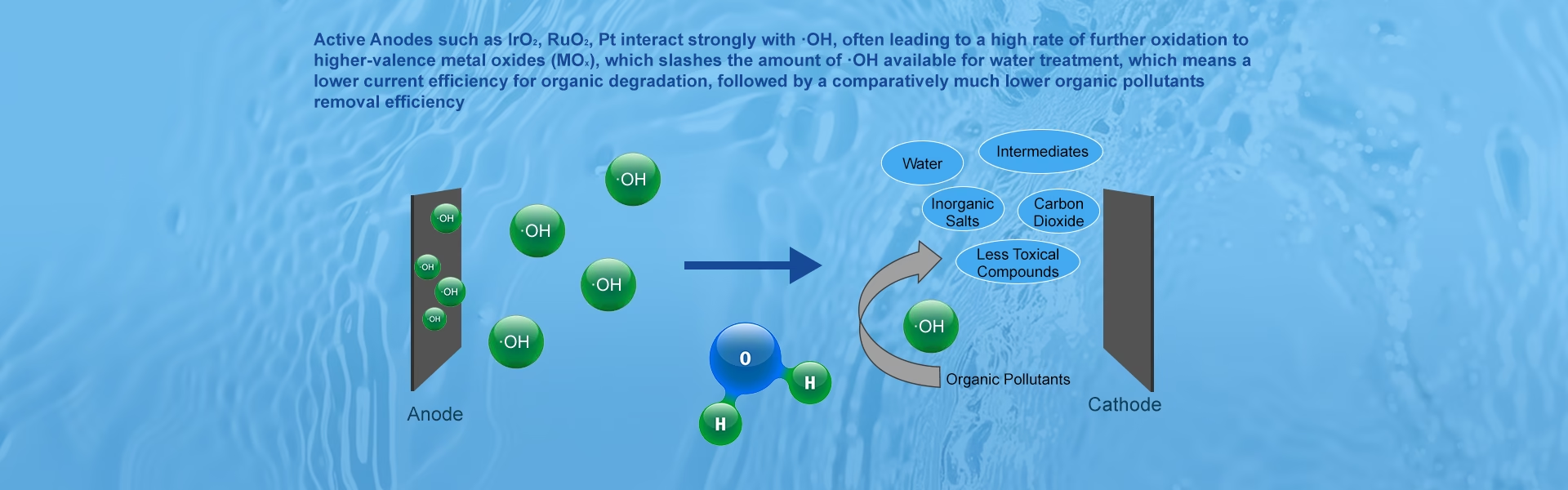
The core distinction between Boron-Doped Diamond (BDD) electrode and Mixed Metal Oxide (MMO) electrode lies in their surface chemistry. Classified as a “non-active“ anode, BDD electrode lacks a significant catalytic surface for the adsorption of organics, which leads to the production of weakly adsorbed, highly reactive hydroxyl radicals (ᐧOH) (Nafiat et al., 2026; “BDD Electrode Vs RUO₂ Anode,” ). In contrast, MMO electrodes are “active” anodes, where the metal oxides (typically IrO₂ or RuO₂) participate directly in the redox cycle, leading to the formation of higher oxidation state metal oxides that favor selective and often partial oxidation.
This context is to discuss major differences of BDD electrode and MMO electrode, on structures, substrates and coatings, chemical parameters, performances in electrochemistry: radical oxidation and oxidant generations, followed by implements in industrial wastewater treatment, as well as municipal wastewater remediations, we hope this content can help you get a better comprehension toward catalyst electrode materials, sharing our two cents on electrode material, especially anode selection.
1. Substrate Architecture and Coating Bonding
BDD electrode: Utilizes Chemical Vapor Deposition (CVD) to grow a p-type semiconductor layer on refractory metals like Niobium or Silicon to fabricate boron doped diamond BDD electrode. The sp³ carbon structure provides extreme hardness and resistance to erosion, making “freestanding” versions significantly more durable than thin-film alternatives (Water Online, 2016).
MMO electrode: Comprises a titanium substrate coated with noble metal oxides. While these are “dimensionally stable,” the coating is applied via thermal decomposition, which is less energy-intensive than CVD but can be susceptible to gradual wear or “passivation” in extreme conditions (Nafiat et al., 2026).
2. Surface Roughness and Active Area
Surfaces of boron doped diamond BDD electrode are characterized by low background currents and wide control over morphology, from ultra-smooth films to micro-crystalline structures. MMO surfaces are inherently porous and rough, which naturally increases the active surface area and supports high current densities at lower cell voltages (Nafiat et al., 2026).
Voltage Windows, Current Density, and Energy Efficiency
The choice between these electrodes often hinges on the oxygen evolution overpotential (OEP). BDD possesses the highest OEP of any commercial material, typically exceeding 2.3 V, compared to approximately 1.5–1.8 V for MMO (Nafiat et al., 2026; “About BDD Electrolysis,” n.d.).
Potential Window: BDD’s wide window allows it to reach high potentials without decomposing water into oxygen gas as quickly as MMO. This suppresses parasitic oxygen evolution and directs energy toward the generation of reactive oxygen species (ROS) (Boromond, 2025).
Current Density: BDD remains stable at extreme current densities (up to 600 A/m² or more), while MMO is often optimized for lower voltage ranges to maximize the life of its oxide coating (ResearchGate, 2011).
Energy Efficiency: For simple pollutants, MMO is more energy-efficient because it operates at lower cell voltages (Nafiat et al., 2026). However, for recalcitrant organic matter (NOM) or “forever chemicals” like PFAS, BDD is more cost-effective because it achieves complete mineralization (CO₂ conversion) whereas MMO may only partially degrade the molecules (ResearchGate, 2026; Boromond, n.d.).
Oxidation Power and Radical Generation
1. Hydroxyl Radical Yield
BDD is the gold standard for producing free hydroxyl radicals. Because these radicals are weakly adsorbed to the diamond surface, they can migrate into the bulk solution to attack pollutants (MDPI, 2023). MMO primarily relies on direct electron transfer and secondary oxidants like active chlorine (if chlorides are present) (Nafiat et al., 2026).
2. Degradation of Refractory Pollutants
Recent studies on Tannery Wastewater and Azo Dyes (like Methyl Orange) show that BDD achieves 98% TOC removal, significantly outperforming MMO in total mineralization (Nafiat et al., 2026; ResearchGate, 2011). BDD electrode is uniquely capable of breaking strong C-F bonds in PFAS, a task where MMO and other traditional electrodes typically fail (ResearchNester, 2026).
Electrode Durability and Maintenance
| Factor | Boron-Doped Diamond (BDD) Electrode | Mixed Metal Oxide (MMO) |
| Chemical Stability | Extremely high; resists strong acids/alkalis | High in brines; sensitive to extreme pH/currents |
| Service Life | Measured in years (freestanding) | Medium to long; coating wears over time |
| Corrosion Resistance | Inert; virtually no leaching | Good; potential for noble metal leaching |
| Maintenance | Resists fouling; tolerates aggressive cleaning | Requires periodic descaling/re-coating |
BDD’s inert nature prevents the material itself from participating in the reaction, which eliminates the risk of heavy metal leaching into treated water—a critical factor for Point-of-Use (POU) consumer devices (“About BDD Electrolysis,” n.d.; Water Online, 2016).
Application Scenarios and System Design
1. Industrial and Municipal Scale
MMO is the preferred choice for bulk electrochlorination and standard wastewater treatment where the primary goal is COD reduction rather than total mineralization (ResearchGate, 2022). BDD is increasingly used as a polishing step for landfill leachate, pharmaceutical waste, and industrial effluents containing toxic, stable intermediates (Water Online, 2016).
2. Consumer Health and Specialized Devices
In compact systems like ozone hydration sprayers or oral care devices, BDD is favored for its ability to generate high-purity ozone and ROS without the need for chemical additives (“About BDD Electrolysis,” n.d.). The market for BDD is projected to grow significantly (CAGR of 9.9% through 2035) as decentralized, high-efficiency water treatment becomes a global priority (ResearchNester, 2026).
Boromond is a leading industrial wastewater treatment solution and service provider dedicated to treating industrial effluent to meet environmental regulations, offering electro oxidation technologies for handling high strength complex waste streams, with our precisely engineered electro oxidation wastewater treatment solutions for wastewater treatment, water reusing and recycling.
Boromond is built by a group of electromists, wastewater treatment experts, industrial lab technicians, environmental compliance specalists, environmental engineers, plant operators, automation technicians, electricians, electrodes maintenance crews, project manager.
References
Boromond. (2025). The Evolution of Boron-Doped Diamond (BDD) in Modern Flow Electrochemistry.
MDPI. (2023). Electrochemical Advanced Oxidation Processes Using Diamond Technology: A Critical Review. Clean Technologies, 10(2). https://doi.org/10.3390/cleantechnol10020025
Nafiat, N., et al. (2026). Multielectrode Advanced Oxidation Treatment of Tannery Wastewater: Process Performance and Energetic Analysis. Journal of Environmental Management.
Boromond. (2025). Boron Doped Diamond Electrode Market Report.
Water Online. (2016). Diamond Electrode Wastewater Treatment Shines Bright.