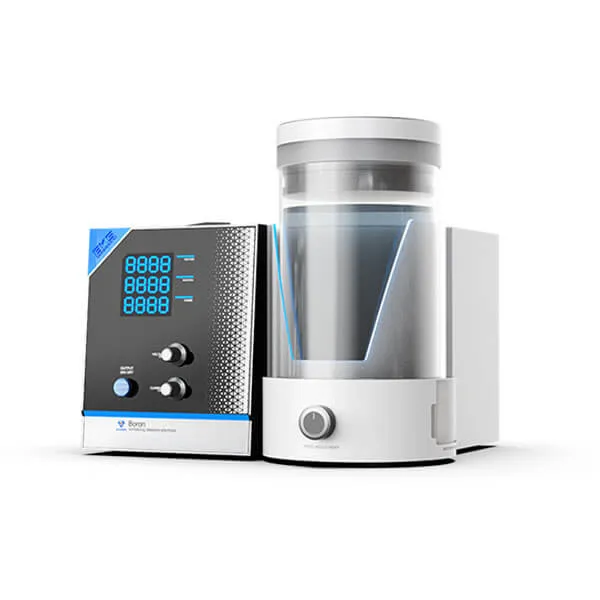
Product Description
The BK5.0 is a plug-and-play laboratory electrolysis test device designed for small-batch wastewater degradation and organic / inorganic synthesis research. Integrated with a Boromond BDD electrode system and a 1 L beaker module, it delivers superior electrochemical performance for research institutes, universities and environmental firms.
At a Glance
170 WRated power — DC 0–15 V / 0–10 A output
1 LSingle-batch processing capacity
≤150 cm²Electrocatalytic area — 2-piece Si/BDD anode
4.2 kgWeight — 280 × 270 × 220 mm
What Is the BK5.0?
Designed for small lab electrolysis tests, the BK5.0 features plug-and-play operation for instant use and high efficiency. Integrated with Boromond BDD electrodes, it delivers superior electrochemical performance for advanced organic and inorganic synthesis. With 1 L processing capacity, it suits research institutes, universities and environmental firms for small-batch testing and water degradation analysis. The dedicated modular beaker kit supports wastewater characterization and electrolytic process development. It is easy to operate, fully compatible with the main device, and allows independent component replacement to fit diverse experimental needs.
Main Performance Parameters
Nameplate
| Rated Power |
170 W |
| Input Voltage / Current |
AC220 V / AC110 V |
| Frequency |
50/60 Hz |
| Output Voltage (DC) |
0–15 V |
| Output Current (DC) |
0–10 A |
Operating Conditions & Housing
| Ambient Temperature |
10–45 ℃ |
| Ambient Humidity |
≤90% |
| Weight |
4.2 kg |
| Overall Dimension |
280 × 270 × 220 mm |
| Housing Material |
Painted sheet metal + acrylic |
BDD Electrode Module Parameters
The BK5.0 is built around the dedicated BK1.0 beaker module, which integrates the BDD electrode stack and glass beaker into a single replaceable unit.
Module
| Specification & Model |
BK1.0 beaker module |
| Dimension |
Φ110 × 165 mm |
| Shell Material |
Nylon + glass fiber |
Anode
| Material |
Si / BDD |
| Dimension |
100 × 50 × 3 mm |
| Quantity |
2 pieces |
| Electrocatalytic Area |
≤150 cm² |
| Anode Carrying Current Density |
0–55 mA/cm² |
Cathode
| Material |
Titanium |
| Dimension |
93 × 74 × 1 mm |
| Quantity |
3 pieces |
Product Advantages
1
Wide Application Scenarios
1 L single-batch processing capacity — ideal for small-batch testing and water degradation qualitative analysis in research institutes, universities and environmental enterprises.
2
Easy & Efficient to Operate
Designed for small laboratories with plug-and-play mode — no extra parts needed, ready to operate once powered on, greatly lowering the entry barrier for operation.
3
Leading Core Technology
Integrated Boromond BDD electrode system with excellent electrochemical properties, providing a new route for cutting-edge organic and inorganic synthesis processes.
4
Flexible & Practical Configuration
The supporting beaker kit is fully compatible with the main unit — versatile and easy to operate, each component can be replaced individually to adapt to various experimental scenarios.
Key Components
- Voltage adjustment button
- Current adjustment button
- Power output button
- Power lead
- BK1.0 beaker module
- Waste liquid collection box
- Magnetic stirrer
Note: As you may have noticed, there are lots of bubbles within the electrolyte during and after electrolysis — this is a normal sign of active oxidation at the BDD anode surface.
Frequently Asked Questions
Q1What is the BK5.0?+
The BK5.0 is a plug-and-play laboratory electrolysis test device designed for small lab tests. Integrated with Boromond BDD electrodes and a 1 L beaker module, it is used for small-batch wastewater degradation testing, water-quality analysis and organic / inorganic synthesis research.
Q2How much can it process at once?+
It offers 1 L single-batch processing capacity, making it ideal for small-batch testing and water degradation qualitative analysis in research institutes, universities and environmental enterprises.
Q3Which electrodes does it use?+
It uses the BK1.0 beaker module, which integrates a 2-piece Si/BDD anode (each 100 × 50 × 3 mm, up to 150 cm² total electrocatalytic area, 0–55 mA/cm² current density) paired with 3 titanium cathodes (93 × 74 × 1 mm).
Q4What are the power & operating requirements?+
It is rated at 170 W with AC220 V / AC110 V input (50/60 Hz) and DC 0–15 V / 0–10 A output. Operating ambient temperature is 10–45 ℃ with ≤90% humidity.
Q5Is it easy to operate?+
Yes. It is designed for small laboratories with plug-and-play mode — no extra parts needed, ready to operate once powered on, with independent voltage and current adjustment buttons for precise control.