
- 21 August 2026
Understanding Food Processing Wastewater: Complex & Possible Solution
Water plays a vital role as a solvent and component in the food processing industry, being used in formulas, mixers, and reactor washing operations. However, to effectively manage the water cycle and ensure proper environmental stewardship, wastewater treatment in the chemical industry is of utmost importance.
The industry’s effluents often contain high concentrations of organic and inorganic compounds, including toxic, carcinogenic, and non-biodegradable substances like surfactants and petroleum hydrocarbons. Therefore, implementing effective wastewater treatment processes has become increasingly crucial. The chemical industry encompasses various activities, such as chemical synthesis, manufacturing, detergent production, fertilizer production, explosives manufacturing, and the production of additives, colorants, resins, and polymers.

An effective wastewater treatment system in the food industry should focus on achieving the following objectives: Reducing COD (chemical oxygen demand), Minimizing ammonium levels, Decreasing sulfates concentration, and lowering chloride content.
Advanced Oxidation Process VS Conventianal Wastewater Treatment
Traditional methods toward food processing wastewater treatment suffer from notable drawbacks such as limited treatment effectiveness, susceptibility to fouling, high energy requirements.Therefore sustainable effluent treatment plant/euquipment based on advanced oxidation process was studied, and then developed to solve the problem.
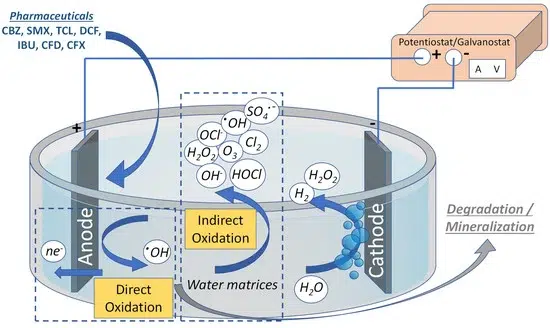
To overcome these limitations, advanced oxidation processes (AOPs) have emerged as innovative water and wastewater treatment techniques. AOPs utilize the oxidative power of hydroxyl (•OH) or sulfate (•SO4–) radicals generated in situ to efficiently eliminate organic pollutants present in aqueous environments. Among AOPs, •OH-based processes have gained significant popularity and widespread acceptance, owing to their exceptional oxidation capabilities.
Electrochemical processes offer several attractive advantages:
Versatility: These processes enable direct or indirect oxidation and reduction, phase separation, concentration or dilution, and biocide functionality, and can be applied to various media and pollutants in gases, liquids, and solids. They are suitable for treating both small and large volumes, ranging from microliters to millions of liters.
Energy efficiency: Electrochemical processes generally require lower temperatures than non-electrochemical alternatives like thermal incineration. Through careful design of electrodes and cells, power losses caused by inhomogeneous current distribution, voltage drop, and side reactions can be minimized.
Automation potential: The inherent variables of electrochemical processes, such as electrode potential and cell current, lend themselves well to process automation, facilitating efficient control and monitoring.
Cost-effectiveness: The construction of electrochemical cells and associated equipment is typically straightforward and, when properly designed, cost-effective.
BDD electrodes (Boron Doped Diamond) are chemically inert electrodes with exceptional properties including a wide potential window, high oxygen evolution overpotential, electrochemical stability, and suitability for the detection of various chemical species at low concentrations.
Hydroxyl radicals is one of the most powerful oxidizing agents
Water is a polar molecule with separate positive and negative ends. When water is electrolyzed, its opposite charges cause it to split into ions at the electrodes. The hydrogen atoms, which form the positive end of water, are attracted to the negative cathode. There, hydrogen ions gain electrons and form hydrogen gas. The oxygen atom forms the negative end of water and is attracted to the positive anode. At the anode, hydroxide ions lose electrons and form oxygen gas.The half-reactions are:Cathode: 2H+ + 2e- -> H2 (Hydrogen ions gain electrons to form hydrogen gas)Anode: O2 + 2H2O + 4e- -> 4OH- (Hydroxide ions lose electrons, and oxygen and water form oxygen gas)In summary, water splits into hydrogen and hydroxide ions when electrolyzed due to its polar nature. The hydrogen ions gain electrons at the cathode to produce hydrogen gas, while hydroxide ions lose electrons at the anode to produce oxygen gas and regenerate water. The reactions at the cathode and anode work in tandem to separate water into its components through the transfer of electrons between electrodes.