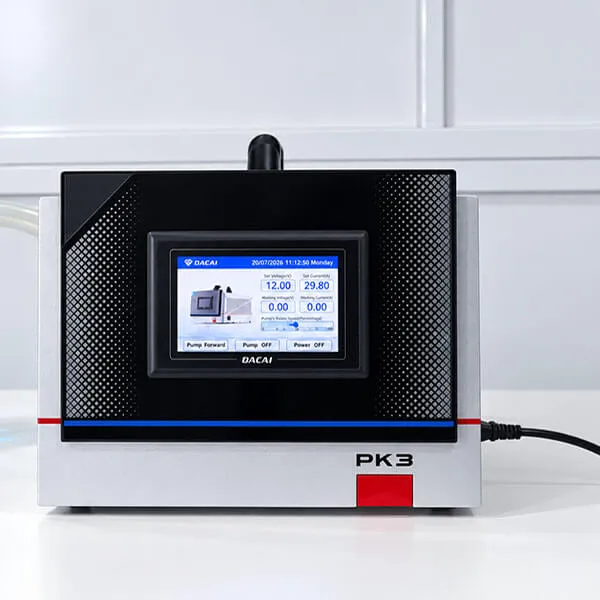
Product Description
The PK3.0 is a portable, ready-to-run BDD electro-oxidation kit — just connect an independent water container and power supply for immediate operation. Its built-in zigzag flow channel boosts the BDD electrode-to-liquid contact area for efficient degradation, with an optimal 2–5 L test volume for wastewater analysis and treatment trials.
At a Glance
440 WRated power — DC 0–12 V / 0–35 A output
2–5 LOptimal water volume per test
540 cm²Sealed active area — 7-piece Nb/BDD anode
12.5 kgTotal weight — 420 × 320 × 290 mm
What Is the PK3.0?
This portable ready-to-run kit only needs connection to an independent water container and power supply for immediate operation. The built-in zigzag flow channel effectively increases the contact area between BDD electrode plates and liquid, improving the efficiency of electrochemical reaction and degradation. It is suitable for quantitative / qualitative analysis and degradation tests of wastewater, meeting demands of research institutions, environmental and sewage treatment enterprises. The optimal water volume per test is 2–5 L. Operable indoors and outdoors with only power supply required, it offers a convenient tool for researchers and engineers to conduct water quality tests at remote sites.
Main Performance Parameters
Nameplate
| Rated Power |
440 W |
| Input Voltage / Current |
AC220 V / AC110 V |
| Frequency |
50/60 Hz |
| Output Voltage (DC) |
0–12 V |
| Output Current (DC) |
0–35 A |
Operating Conditions & Housing
| Ambient Temperature |
10–45 ℃ |
| Ambient Humidity |
≤90% |
| Pump Flow |
0–3 L/min |
| Total Weight |
12.5 kg |
| Overall Dimension |
420 × 320 × 290 mm |
| Housing Material |
Aluminum alloy + ABS |
BDD Electrode Module Parameters
Module
| Name |
BDD electrode module |
| Dimension |
220 × 180 × 160 mm |
Anode
| Material |
Nb / BDD |
| Dimension |
100 × 50 × 1 mm |
| Quantity |
7 pieces |
| Sealed Active Area |
540 cm² |
| Current Density |
0–55 mA/cm² |
Cathode
| Material |
Titanium |
| Dimension |
100 × 50 × 1 mm |
| Quantity |
8 pieces |
Application Scenarios
Electrolysis of anhydrous glucose via PK3.0 — simulated COD variation trends in high-concentration organic wastewater. Anhydrous glucose was used to simulate high-concentration organic wastewater for a BDD electrochemical oxidation reaction. Under a current density of 55 mA/cm² and a reaction time of 3 hours, COD was measured on multiple water samples. The data show a clear downward COD trend as oxidation proceeds.
| Time (h) |
COD Trend 1 (mg/L) |
COD Trend 2 (mg/L) |
| 0 |
10000 |
6000 |
| 0.5 |
9866.5 |
5150 |
| 1 |
4310 |
1260 |
| 1.5 |
986 |
456 |
| 2 |
282 |
112 |
| 2.5 |
34 |
64 |
| 3 |
4.75 |
30 |
Key Features
1
Portable & Ready-to-Run
Only needs connection to an independent water container and power supply for immediate operation.
2
Zigzag Flow Channel
The built-in flow channel increases the contact area between BDD electrode plates and liquid, improving electrochemical reaction and degradation efficiency.
3
Optimal 2–5 L Test Volume
Suited for quantitative / qualitative analysis and degradation tests of wastewater for research institutions, environmental and sewage treatment enterprises.
4
Indoor & Outdoor Operation
Requires only a power supply, making it a convenient tool for water-quality tests at remote sites.
Frequently Asked Questions
Q1What is the PK3.0?+
The PK3.0 is a portable, ready-to-run BDD electro-oxidation kit for wastewater analysis and degradation tests. It only needs an independent water container and a power supply to start operating immediately.
Q2How much water can it process per test?+
The optimal water volume per test is 2–5 L, making it well suited for quantitative / qualitative analysis and degradation tests of wastewater.
Q3Which electrodes does it use?+
It uses a 7-piece Nb/BDD anode (each 100 × 50 × 1 mm, 540 cm² sealed active area, 0–55 mA/cm² current density) paired with 8 titanium cathodes (100 × 50 × 1 mm), assembled in a 220 × 180 × 160 mm module.
Q4What are the power requirements?+
It is rated at 440 W with AC220 V / AC110 V input (50/60 Hz) and DC 0–12 V / 0–35 A output. Operating ambient temperature is 10–45 ℃ with ≤90% humidity and a 0–3 L/min pump flow.
Q5Can it run at remote sites?+
Yes. It operates indoors and outdoors with only a power supply required, giving researchers and engineers a convenient way to conduct water-quality tests away from the lab.